- Your firm should own the domain, website, content and ad accounts, in its own name.
- Be wary of guarantees, long lock-ins and vague answers about links.
- Ask to see live sites, a real monthly report and the person you’ll actually talk to.
1–3. Who owns what, and what happens if you leave
1. Who owns the domain, the website and the content? Your domain is your address online. If an agency registers it in its own name, leaving gets hard.
- Good answer: “The domain is registered to your firm and you get the logins. You own the site and every page we write.”
- Worrying answer: “Don’t worry, we take care of all that.” No names, no logins.
2. Who owns the Google Ads and Analytics accounts? Google’s guide for advertisers says an agency “must set up a separate Ads account for you.” In Google Ads, the admin access level controls who gets access, so your firm should hold it.
- Good answer: “The accounts are in your firm’s name. You’re an admin, and we have our own access.”
- Worrying answer: “Your ads run in our account.”
3. What happens to my site if I leave? Some agencies build on their own platform and rent it to you. When you leave, the site stays with them.
- Good answer: “We hand over the files, logins and redirects. You can move it anywhere.”
- Worrying answer: “The site is licensed to you while you’re a client.”
Do this: put ownership in the contract, before any work starts.
4–5. Contract length and competitors
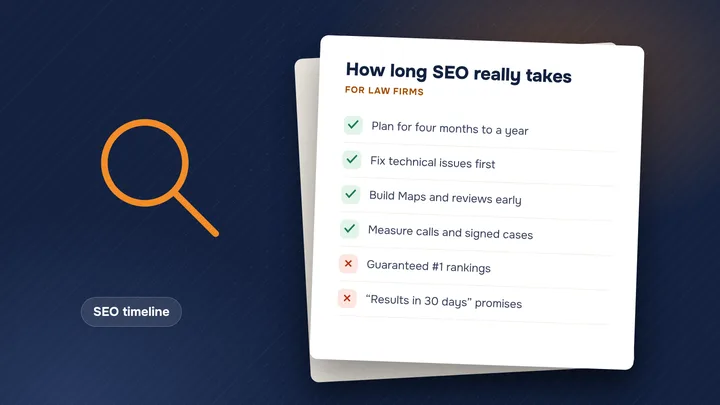
4. How long is the contract, and how do I get out? SEO takes months (see how long law firm SEO takes), so some commitment is fair. A long term with a big exit fee is different. Google also tells advertisers to “get an official copy of your agreement in writing.”
- Good answer: A short first term, then month to month, with a clear notice period.
- Worrying answer: Automatic renewals, a fee to cancel, or no written contract at all.
5. Do you work with other firms in my practice area and city? Only one firm can be first on Google Maps for “car accident lawyer Glendale.” An agency with three clients there has to choose who gets its best work.
- Good answer: A clear yes or no, and a written promise if it matters to you.
- Worrying answer: “It’s not a conflict, we treat everyone the same.”
6–8. Content, links and State Bar rules
6. Who writes the content, and does an attorney approve it? The State Bar’s rules apply to what your firm publishes, and the attorney answers for it, not the agency.
- Good answer: “A writer who knows legal topics drafts it. An attorney at your firm approves every page before it goes live.”
- Worrying answer: “We publish 30 AI posts a month.” Nobody at the firm reads them.
7. How do you build links? Links from other sites help you rank. Buying them doesn’t: Google’s spam policies list “exchanging money for links” as link spam. Google also says “you should never have to link to an SEO.”
- Good answer: Bar associations, local news, real community work and complete legal directory profiles, with examples they can show you.
- Worrying answer: “We have a private network of high-authority sites,” or a hidden link to the agency in your footer.
8. How do you handle State Bar advertising rules? Rule 7.1 bans false or misleading statements, and its comments flag guarantees of results. Rule 7.2 requires the name and address of a responsible lawyer or firm. Rule 7.4 limits who can say “certified specialist.”
- Good answer: “We write to Rules 7.1 to 7.4, and your attorney gives final approval.”
- Worrying answer: “Everyone says ‘best lawyer.’ It’s fine.”
Our California advertising rules checklist has the details. For real ethics questions, ask an ethics counsel.
9–10. Reports and the person you’ll talk to
9. What do you report each month? Google’s page “Do you need an SEO?” suggests asking “How do you measure your success?” and “Will you share with me all the changes you make to my site?”
- Good answer: Calls, forms and signed cases by source, ad spend, and a list of what changed on the site.
- Worrying answer: Pages of keyword rankings and nothing about cases.
10. Who will I actually talk to? In our experience, firms often meet a senior person on the sales call and someone else after they sign.
- Good answer: A named person who does or directs the work, with a direct phone number or email.
- Worrying answer: A ticket system, and a new contact every few months.
11–12. Proof and money
11. Can I see live sites you built? Google’s own list starts with “Can you show me examples of your previous work?”
- Good answer: Real firm websites you can open today, and permission to call one or two of those clients.
- Worrying answer: Only screenshots and mockups, or “our clients are confidential.”
12. Who is my ad spend paid to? Google says you have the right to know “the number of clicks, impressions, and the total cost” of your ads. Its transparency rules for agencies require management fees to be disclosed in writing and on invoices, and reported costs to be what Google charged, without the agency’s fees.
- Good answer: “Google bills your card directly. Our fee is a separate line.”
- Worrying answer: One bundled monthly number, with no way to see what Google charged.
One more red flag: guarantees. Google says “No one can guarantee a #1 ranking on Google,” and if someone promises first place, to “find someone else.”
How we answer these questions
A good agency can answer all twelve in a short call, in plain words. For what it’s worth, here are araRank’s answers: your firm owns the domain, the site, the content and every ad account. We don’t do long contracts. And we work with one firm per practice area per city.
Do this: send these questions to every agency on your list, in writing, and compare the answers side by side. Then check their work yourself: run a site they built through our free website check.
Want help with this? See All araRank services.
Sources
- Google Search Central: Do you need an SEO?
- Google Search Central: Spam policies for Google web search
- Google Ads: Advertiser guide – Working with third parties
- Google Ads: Transparency requirements for third parties
- Google Ads Help: About access levels in your Google Ads account
- State Bar of California: Rules of Professional Conduct, Chapter 7
Not sure what your agency built for you?
Check your website free in 30 seconds and get a plain list of what to fix.

Sevag is the founder of araRank and a web developer with 6 years in law firm marketing and SEO. He builds every site we make, from Los Angeles.
About Sevag →